

EB-3 Visa Sponsorship ROI for Employers: EB3.Work’s Workforce ROI Calculator Earns Registered Trademark
EB3.Work Workforce ROI Calculator helps employers model long-term workforce return on investment
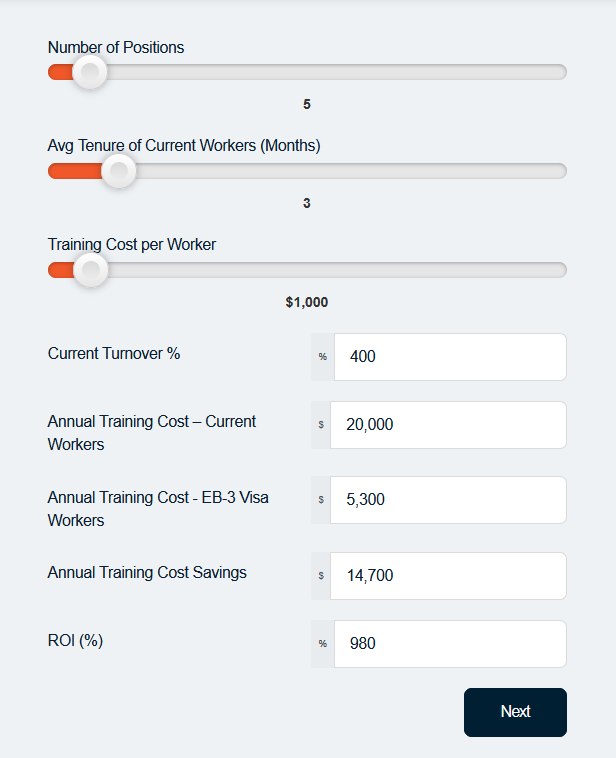
Screenshot of the EB3.Work Workforce ROI Calculator planning tool

John Dorer (CEO, EB3.Work)
Registered Trademark milestone reflects rising employer demand for cost transparency across PERM, prevailing wage, onboarding, and workforce turnover
The Workforce ROI Calculator is available at: https://employer.eb3.work/roi-calc/
As more employers plan for 2026 staffing needs in industries where retention, attendance, and long-term workforce stability directly affect operational performance, EB3.Work reports a clear shift in employer decision-making: organizations are moving beyond “cost per hire” and toward a more complete view of return on investment (ROI). That broader view includes not only direct immigration and compliance costs, but also the ongoing business costs that often determine whether a workforce strategy succeeds or fails, such as prevailing wage requirements, training and onboarding time, productivity ramp-up, and the financial impact of chronic employee turnover.
“Employers aren’t just asking whether EB-3 is possible - they’re asking whether it makes financial sense,” said John Dorer, CEO of EB3.Work. “The Workforce ROI Calculator was built to quantify the factors employers already experience every day: turnover replacement costs, overtime pressure, onboarding repetition, and wage compliance. The Registered Trademark milestone reflects our long-term commitment to providing reliable planning tools for employers who want to make informed decisions.”
Why EB-3 Visa Sponsorship ROI Matters Heading Into 2026
For many employers, especially those operating with thin margins or high labor volatility, the biggest hidden cost is not a single fee or form. It is uncertainty: unpredictable churn, repeated onboarding cycles, inconsistent attendance, and the operational drag created when teams remain understaffed for extended periods.
While EB-3 is fundamentally an immigration pathway, employer outcomes are often driven by business variables that exist regardless of the visa category. In practice, many employers compare EB-3 sponsorship ROI against the ongoing financial pattern they already know too well: recruiting spend that repeats every month, training that never compounds, and productivity gaps that force overtime or reduce output.
EB3.Work says the reason ROI analysis has become more urgent is simple. In many organizations, labor is no longer a line item to optimize quarterly. It is a multi-year capacity strategy. Employers increasingly need to model outcomes across a longer planning horizon, especially when hiring decisions involve permanent roles, regulatory compliance, and long-term workforce commitments.
What the Workforce ROI Calculator Measures
The EB3.Work Workforce ROI Calculator is designed to help employers estimate ROI by comparing two scenarios: the ongoing cost of staffing under current conditions versus the modeled cost of stabilizing labor through longer-term workforce planning.
Rather than focusing narrowly on a single fee category, the tool is built around the reality that employers experience labor costs in multiple layers. Those layers typically include:
1. Workforce churn and replacement costs.
Employers often underestimate the full economic impact of churn, which can include recruiting and advertising spend, manager time, training hours, safety incidents, quality drift, attendance gaps, and the loss of productivity while new hires ramp up.
2. Wage compliance and labor planning.
When employers consider EB-3 sponsorship, prevailing wage obligations and compliance planning become critical components of the model. Employers need clarity on what compensation levels may be required for specific roles and locations, and how wage planning affects long-term labor budgets.
3. Onboarding and ramp-up time.
In many high-turnover environments, onboarding is one of the most expensive repeating cycles. Employers absorb costs that accumulate quietly: trainer hours, overtime to cover vacancies, reduced throughput while new hires learn processes, and the operational burden on experienced staff.
4. Forecasting stability over time.
ROI models are rarely about a single moment. Employers want to understand what changes when labor becomes more predictable: fewer open shifts, fewer staffing emergencies, less operational volatility, and improved ability to forecast labor capacity.
EB3.Work notes that the calculator is meant to support planning conversations, not replace legal or financial advice. Employers should confirm any assumptions and compliance requirements with qualified professionals.
The Trademark Milestone: Why It Matters to Employers
In a market where “calculators” and “estimators” are often generic, the Registered Trademark approval signals that EB3.Work is building a long-term employer toolkit around workforce decision-making - not simply publishing one-off content.
Employers evaluating EB-3 sponsorship often face the same challenge: cost discussions are fragmented. One vendor focuses on forms, another focuses on recruiting, another focuses on operations, and none of them connect the numbers to the actual business outcome: retention-driven stability and measurable ROI.
The trademarked Workforce ROI Calculator is intended to help employers unify the model. Instead of treating sponsorship decisions as a purely administrative expense, employers can evaluate how sponsorship may influence costs that already exist inside the business, including churn, overtime pressure, and recurring onboarding.
“Employers don’t need hype. They need clarity,” Dorer added. “We built the Workforce ROI Calculator to make the decision measurable, not emotional. The trademark is a milestone, but the bigger goal is helping employers plan responsibly and transparently.”
EB-3 Visa Sponsorship ROI Is Not One Number
EB3.Work emphasizes that EB-3 visa sponsorship ROI can vary widely by role, location, and employer operating environment. Two organizations in the same industry may experience very different ROI outcomes depending on their baseline turnover rate, training intensity, schedule predictability, and wage structure.
A meaningful ROI model typically starts with a clear baseline: what does the employer spend today to keep a position filled for an entire year? That baseline often includes the visible line items as well as the operational costs that rarely appear in a spreadsheet until a leadership team explicitly models them.
For many employers, the most common ROI mistake is underestimating “repeat costs.” When turnover remains high, the employer pays the same onboarding and recruiting costs multiple times per year for the same role. The Workforce ROI Calculator is designed to bring those repeat costs into view so decision-makers can compare them against long-term workforce strategies.
How Employers Use ROI Modeling Before Sponsorship Decisions
Employers typically use ROI analysis in three stages:
First, they define the operational problem in measurable terms: open-shift frequency, overtime reliance, replacement hiring volume, training bandwidth, and retention performance.
Second, they translate those operational patterns into costs: how much churn costs per role per year, how long onboarding takes, and what staffing volatility costs in lost throughput or service quality.
Third, they compare options: continued short-term hiring cycles versus multi-year workforce planning models where stability and retention can change the cost curve.
In that context, EB-3 visa sponsorship is evaluated not only as a compliance pathway, but as an investment decision - one that must be justified with real numbers and conservative assumptions.
FAQ: Workforce ROI Calculator and Long-Term EB-3 Workforce Value
1. What is the Workforce ROI Calculator designed to show employers?
The Workforce ROI Calculator is designed to help employers quantify the financial impact of workforce stability. It compares the ongoing cost of training and replacing short-tenure employees with the projected cost of retaining EB-3 visa workers who commit to long-term employment, typically 12 months or more. The goal is to make workforce decisions measurable using real operational inputs.
2. Who should use the Workforce ROI Calculator?
The calculator is intended for HR leaders, CFOs, operations managers, and executives responsible for workforce planning. It is particularly useful for organizations managing large numbers of entry-level or hourly positions where turnover, training repetition, and staffing volatility materially affect operating costs.
3. What inputs does the Workforce ROI Calculator use?
The calculator allows employers to adjust key variables such as:
• Number of positions
• Average employee tenure
• Training cost per worker
These inputs reflect real conditions inside the business and directly influence the projected cost of turnover and the potential savings from improved retention.
4. How does employee tenure affect the calculator’s output?
Employee tenure is one of the most powerful inputs. When average tenure is short - for example 2 to 6 months - training and onboarding costs repeat multiple times per year for the same role. Extending tenure to 12 months or longer significantly reduces how often those costs recur, which is why the savings curve increases sharply as retention improves.
5. Why does the calculator emphasize a 12-month employment period?
A 12-month employment period represents a meaningful stability threshold. EB-3 visa workers will stay for at least 12 months. At that point, employers typically recover training investments, reduce onboarding repetition, and experience fewer operational disruptions. The calculator illustrates how reaching or exceeding this threshold changes annual training costs and long-term workforce economics.
6. How does scaling the number of positions change the results?
The calculator is designed to reflect scale. For employers managing dozens or hundreds of entry-level roles, even modest improvements in retention can translate into six-figure annual savings. The tool shows how workforce instability compounds at scale - and how stabilizing larger teams produces disproportionately larger financial impact.
7. Why are training costs such a critical factor in the model?
Training costs are one of the most underestimated expenses in high-turnover environments. Beyond formal training materials, employers invest supervisor time, productivity ramp-up, overtime coverage, and quality control. When employees leave quickly, these costs repeat continuously. The calculator brings these recurring costs into clear view.
8. How does the calculator compare short-term turnover to long-term retention?
The model contrasts two patterns: frequent replacement cycles versus longer employee tenure. Short-term turnover forces employers to restart training and onboarding multiple times per year. Longer retention reduces repetition, allowing training investments to compound instead of reset, which is where long-term value is created.
9. What makes the “100-position” example especially compelling?
Large employers often experience the greatest financial impact from turnover. In the example of 100 entry-level positions with short average tenure, annual training costs can approach several hundred thousand dollars. When retention improves, those costs decline dramatically, producing six-figure savings that directly affect the bottom line.
10. How should employers interpret the ROI percentage shown?
The ROI percentage illustrates how much financial return results from reducing repeated training and replacement costs relative to the modeled investment. It is not a promise or guarantee, but a way to visualize how workforce stability can dramatically change cost structures when turnover is reduced.
11. Does the calculator replace financial or operational analysis?
No. The calculator is a planning tool meant to support internal discussions and scenario modeling. Employers should validate assumptions with their own data and use the calculator alongside broader workforce, financial, and operational analysis.
12. How does changing the training cost input affect results?
Higher training costs increase the financial penalty of turnover. When training is expensive - due to safety requirements, complexity, or productivity ramp-up - short employee tenure becomes especially costly. The calculator shows how stabilizing the workforce protects these investments over time.
13. Why is workforce stability considered a strategic advantage?
Stable teams reduce operational volatility. Employers experience fewer open shifts, less overtime pressure, more predictable scheduling, and improved productivity. The calculator helps quantify how these operational improvements translate into financial outcomes over an annual planning horizon.
14. How do employers typically use the calculator in decision-making?
Many employers use the calculator to:
• Test different retention scenarios
• Compare current turnover patterns to longer-term staffing strategies
• Align leadership around workforce planning assumptions
It provides a shared, data-driven framework for conversations that are often based on estimates or intuition.
15. What is the best way to use the Workforce ROI Calculator responsibly?
Employers should use realistic inputs, model multiple scenarios, and treat results as directional insights rather than precise forecasts. The purpose is to understand how retention changes cost behavior - not to predict exact outcomes. Used correctly, the calculator helps employers make more informed, transparent workforce decisions.
About EB3.Work
EB3.Work is a U.S.-based employment and immigration support platform connecting international applicants with verified American employers participating in the EB-3 visa program. The company publishes employer-focused planning tools and educational resources, including its Workforce ROI Calculator, to support responsible workforce decisions and long-term staffing strategies.
Workforce ROI Calculator: https://employer.eb3.work/roi-calc/
Website: https://eb3.work
Media Contact
EB3.Work
1850 Amsterdam Ave.
New York, NY 10031
📞 866.337.1403
📧 johnd@eb3.work
Marketing Team
EB3.Work
email us here
Visit us on social media:
LinkedIn
Instagram
YouTube
TikTok
Legal Disclaimer:
EIN Presswire provides this news content "as is" without warranty of any kind. We do not accept any responsibility or liability for the accuracy, content, images, videos, licenses, completeness, legality, or reliability of the information contained in this article. If you have any complaints or copyright issues related to this article, kindly contact the author above.
